Pull the insulation back in a Winter Garden attic and you find the same thing in house after house: flex collar connections hanging open, runs sagging between hangers, and duct tape where mastic should have been applied 30 years ago. The system is still running. The bill keeps climbing. Most homeowners assume the equipment is aging — nine times out of ten, the problem lives in the attic.
When conditioned air escapes through failed joints before it reaches your living space, your HVAC system works harder for less output. Humidity and dust enter the duct stream through the same leaks letting your cool air out. In Florida’s nine-month cooling season, a 25-percent leakage rate is not a periodic problem. That’s real money leaving through your attic every hour the system runs.
Our technicians are Florida DBPR-licensed and have spent years repairing duct systems in homes across Orange County. We inspect, diagnose, repair, and pressure-test every job. Getting the ductwork right changes what your system can actually do, and changes the air quality while it does it.
TL;DR Quick Answers
Air Duct Repair in Winter Garden
Air duct repair in Winter Garden restores the conditioned air your HVAC system is producing but losing before it reaches your rooms. The most common failures we find in Winter Garden homes are separated flex duct joints at collar connections, mastic breakdown at supply trunk takeoffs, crushed runs in attic kneewall spaces, and disconnected register boots — failures that show up consistently in homes built across western Orange County before Florida's 2009 Energy Code tightened sealing requirements.
What the repair process covers:
Borescope inspection to locate all failure points before any materials are opened
Mastic sealant applied by hand at each joint, with UL-181 foil tape where code requires it
Metal draw bands and collars to reconnect separated flex runs — not duct tape, which fails in Florida's heat
Post-repair pressure test to confirm leakage dropped to an acceptable level
What Winter Garden homeowners should know before scheduling:
Florida DBPR requires a state license for HVAC duct work — verify any contractor at MyFloridaLicense.com before scheduling
Most single-zone residential repairs finish in one visit of three to five hours
Top Takeaways
Duct leakage is a documented energy problem. ENERGY STAR research shows that in a typical home, 20 to 30 percent of conditioned air is lost through duct leaks before it reaches the living space. In Florida’s long cooling season, that loss runs continuously from April through October.
Central Florida’s climate accelerates duct deterioration. Attic temperatures in Orange County homes regularly exceed 130°F in summer. Flex duct jacket material degrades under sustained heat exposure, and humidity above 70 percent during peak season drives moisture into unsealed joints, producing the kind of failure we see routinely in pre-2005 construction.
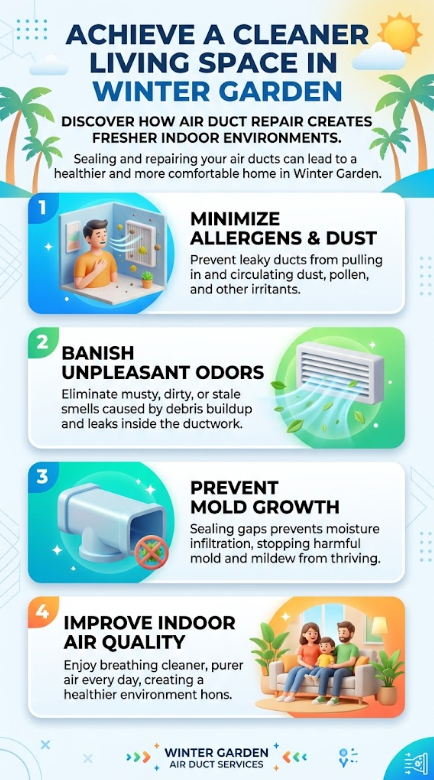
Indoor air quality is tied directly to duct integrity. The EPA reports that indoor pollutant concentrations are often 2 to 5 times higher than outdoor levels. When ducts leak, they pull dust, insulation particles, and mold spores from your attic directly into the conditioned air stream.
Florida licensing protects you. Duct work performed by an unlicensed contractor can void equipment warranties and fail a home inspection. Florida DBPR license verification takes under two minutes at MyFloridaLicense.com.
Repair is not always the whole answer. Isolated joint separations, small punctures, and single-zone mastic failures are repair-eligible. A duct system that is 30-plus years old with widespread deterioration often calls for replacement. A thorough inspection tells us which situation you’re in before any work begins.
What HVAC Duct Repair Actually Fixes
What we repair depends on what’s failing — and in Winter Garden homes, we’ve found a consistent set of culprits. The four issues we encounter most are separated flex duct joints at collar connections, mastic failure at supply trunk takeoffs, crushed or kinked flex runs in attic kneewall spaces, and deteriorated duct boards around air handler plenums.
Each one affects performance differently. A separated collar connection leaks conditioned air directly into your attic. Mastic failure at a takeoff means a supply branch has been losing air through a widening gap. Crushed flex limits airflow to an entire zone — often explaining why one bedroom runs warmer than every other room in the house. We address each failure on its own terms.
Why Winter Garden Homes Face Specific Duct Challenges
Orange County’s western residential belt, including Winter Garden, Ocoee, and the SR-50 and 429 corridors, saw significant development from the late 1980s through the early 2000s. Homes built during that window typically use fiberglass flex ducts installed before Florida’s 2009 Energy Code updates tightened sealing requirements. A 35-year-old flex duct system running in an unconditioned attic has spent three and a half decades cycling through Florida’s heat and humidity under standards we now know were inadequate.
That history shows up every time we inspect. We find collar connections sealed with duct tape instead of mastic and draw bands, flex runs sagging and kinking between undersized hangers, and air handler plenums with gaps that have widened as the structure shifted over decades. That’s the expected condition of a duct system from that construction era. The question is what those failures are doing to your comfort and your Duke Energy bill today.
The Repair Process: From Inspection to Pressure Test
We inspect before we repair. That matters, because the right fix depends on knowing exactly what has failed and where. Our technicians use a borescope to examine inaccessible duct runs and map leak locations before we open a can of mastic. We evaluate the air handler plenum and all accessible collar connections. For jobs where total system performance is in question, we run a duct blaster to measure leakage before and after, so you can see the improvement in numbers, not just feel it.
We apply mastic sealant by hand at each joint, with UL-181 foil tape for additional reinforcement where code requires it. Separated flex runs get reconnected with metal draw bands and collars, not duct tape, which cracks and fails in Florida’s heat. Crushed sections get straightened and re-hung or replaced outright. Every job ends with a pressure test to confirm the repair actually worked.

“The houses we work in most often around Winter Garden were built when flex ducts were installed fast and sealed with tape — which means by the time we’re standing in the attic, the tape is long gone and the collar is hanging open. Homeowners are almost always surprised when we show them, because the house felt like it was just running inefficiently. It was — but the fix was in the attic the whole time, not in the equipment.”
Essential Resources
1. EPA — Introduction to Indoor Air Quality
The EPA’s primary resource on indoor pollutants, sources, and health effects. Foundational authority for IAQ claims throughout this page.
URL: https://www.epa.gov/indoor-air-quality-iaq/introduction-indoor-air-quality
2. EPA — The Inside Story: A Guide to Indoor Air Quality
Covers how duct systems, building materials, and ventilation affect the air families breathe at home.
URL: https://www.epa.gov/indoor-air-quality-iaq/inside-story-guide-indoor-air-quality
3. ENERGY STAR — Duct Sealing
Source for the 20–30% duct leakage statistic. Explains the efficiency impact of leaky ducts and what sealing accomplishes.
URL: https://www.energystar.gov/saveathome/heating-cooling/duct-sealing
4. U.S. Department of Energy — Minimizing Energy Losses in Ducts
DOE guidance on duct system performance, leakage causes, and the case for professional repair over DIY tape fixes.
URL: https://www.energy.gov/energysaver/minimizing-energy-losses-ducts
5. NADCA — National Air Duct Cleaners Association
The industry certification body for HVAC inspection, maintenance, and restoration standards. Reference for professional duct work benchmarks.
6. Florida DBPR
The Florida Department of Business and Professional Regulation’s public license verification portal. Confirm any HVAC contractor’s license here before scheduling work.
URL: https://www.myfloridalicense.com
7. Wikipedia — Winter Garden, Florida
Geographic and demographic context for Orange County’s western residential market, including population data and community profile.
URL: https://en.wikipedia.org/wiki/Winter_Garden,_Florida
Supporting Statistics
1. Duct Leakage Wastes 20 to 30 Percent of Conditioned Air
ENERGY STAR reports that in a typical house, 20 to 30 percent of the air moving through the duct system is lost due to leaks, holes, and poorly connected ducts, resulting in higher utility bills and persistent comfort problems regardless of thermostat setting. In a Florida home running its AC nine months a year, that loss runs continuously.
Source: ENERGY STAR — Duct Sealing
2. Indoor Air Can Carry Pollutant Concentrations 2 to 5 Times Higher Than Outdoors
The EPA reports that Americans spend approximately 90 percent of their time indoors, where the concentrations of some pollutants are often 2 to 5 times higher than typical outdoor concentrations. Duct leaks compound this problem. They pull unconditioned attic air into the conditioned air stream circulating through every room, bringing dust, insulation particles, and biological contaminants with it.
Source: EPA — Indoor Air Quality (Report on the Environment)
3. Leaky Ducts Can Add Hundreds of Dollars Per Year to Heating and Cooling Bills
The U.S. Department of Energy states that ducts leaking conditioned air into unheated or uncooled spaces can add hundreds of dollars a year to heating and cooling costs. The DOE identifies sealing and insulating ducts in unconditioned spaces, including attics, crawlspaces, and garages, as one of the most cost-effective improvements a homeowner can make to an existing system.
Source: U.S. Department of Energy — Minimizing Energy Losses in Ducts
Final Thoughts
Duct repair is easy to delay because the evidence is mostly invisible. Your rooms are a little uneven. The bill went up, but Florida summers are always hot. The AC is older, so naturally it runs harder. We’ve walked through enough Winter Garden homes to know that this line of thinking almost always points to a duct problem, not an equipment problem.
What we’d tell a neighbor who asked us directly: if your home was built before 2005 and the duct system has never been inspected, it’s worth a look. We say that not because something is definitely wrong, but because the probability of a sealing failure in a 20-plus-year flex duct system in a Florida attic is high enough that an inspection earns its time. In most cases we find something. In the rest, we confirm the ducts are sound — and that has value too.
The homes we work in around Winter Garden are built to last. The duct systems in their attics deserve the same attention as every other maintained system in the house. When the ductwork is right, everything runs the way it was designed to — quieter, more even, and less expensive to operate every month.
Frequently Asked Questions
How do I find a licensed HVAC duct repair company in Winter Garden?
Florida DBPR requires HVAC contractors to hold a state license for duct work. Before scheduling any contractor, ask for their license number and verify it at MyFloridaLicense.com. Also ask what diagnostic tools they use. A contractor who skips pressure testing has no way to confirm the repair worked. And confirm they carry general liability insurance before anyone goes into your attic.
What are the signs that my air ducts need repair?
The most reliable indicators are rooms that consistently fall short of the thermostat setting, Duke Energy bills that climbed without a corresponding change in usage or weather, and dust that returns to surfaces faster than normal. Musty or stale air near vents points specifically to duct leaks — in Florida homes, attic air drawn into the system brings humidity and biological content into rooms it shouldn’t reach.
Is HVAC duct repair worth it for a Florida home?
In most cases, yes. A repair pays back faster here than in northern markets. Florida’s cooling season runs nine months, not three, so a leaking duct system loses conditioned air for the better part of the year. The IAQ benefit applies year-round: less attic air in your conditioned stream means cleaner indoor air in every season.
How long does HVAC duct repair take?
A straightforward repair, typically one or two failure points in an accessible attic space, finishes in a single visit of three to five hours. Whole-system re-sealing across a larger home or a job with multiple access complications may need a second appointment. We give you a realistic time estimate after the inspection, before work begins.
Can I repair air ducts myself?
Some visible, accessible failures are within a capable homeowner’s reach. Use mastic sealant or UL-181 foil tape, not standard duct tape, which cracks and fails in Florida’s heat. Most duct damage in older Winter Garden homes is in unconditioned attic spaces, requires correct mastic technique and pressure validation to meet Florida Energy Code, and is safest with a licensed HVAC contractor handling access and materials.
Cleaner Air Starts With the Ducts Behind Your Walls
Winter Garden homes running 25-year-old flex duct systems are losing conditioned air into the attic every hour the AC runs — we find the failure, fix it with mastic and pressure testing, and confirm the results before we leave. Schedule your duct repair estimate in Winter Garden and we'll tell you exactly what we find.Here is the nearest branch location serving the Edgewater FL area…
Filterbuy HVAC Solutions - West Palm Beach FL
1655 Palm Beach Lakes Blvd ste 1005, West Palm Beach, FL 33401, United States
(561) 448-3760